A French Frigate named
L'Heureux
I currently have three accounts of a french frigate named L'Heureux.
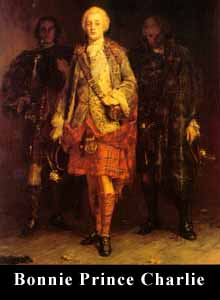
- First, as a boat having been used to return
Bonnie Prince Charles to France after his unsuccessful attempt at
the throne of Scotland in 1746.
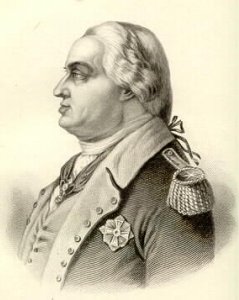
- Second, as a frigate having been used in 1777
to transport Baron Von Steuben to America where he became famous by
writing a book of regulations for George Washington's army.
- Thirdly, in connection with the Battle of the
Nile in 1798.
The L'Heureux is apparently described on page 176 of The
Search for Speed Under Sail, Howard I. Chapelle, 1700-1855. New
York: W.W. Norton & Co., 1967. For more research, see Maritime
History on the Internet by Peter
McCracken. The L'Heureux is listed in the Index
of Ships which contains 140,000 ships.
If you have others, please contact me.
 Bonnie
Prince Charles Connection Bonnie
Prince Charles Connection
Email from Sandra Kasa (née L'Heureux) from UK
In a recent Email, Sandra says,
"Il y quelques années j'ai visité Culloden
Moor en Ecosse, lieu d'une bataille (1746) entre les Anglais et les
Jacobites pour remettre le "Bonny Prince Charles" (Charles Stuart) sur
le trone de l'Ecosse. Ce fut une bataille sanglante, le prince
s'est echappé et a vécu en cachette dans les iles de la
côte ouest de l'Ecosse, tandis que ses sympatisants en Europe,
particulièrement en France se chargèrent de le livrer
de son sort. Deux ans plus tard il se fuit en destination de la France
dans un bateau breton nommé le L'HEUREUX,
probablement le nom de capitaine du vaisseau. Voici donc que le nom
L'Heureux se trouve en Ecosse." (English
translation)
Starting with with this initial email, I found the following accounts.
John O’Sullivan of Cappanacuss Castle by Anne McCabe
She says,
"On the 1st October 1746 O'Sullivan got on board a French
cutter that had to outrun a British ship that was searching for Charles,
and head for Norway. From thence he sailed to France to find a neutral
ship that would return to take the Prince to safety.
The L'Heureux was at last dispatched
and picked up Charles at Loch na nUamh where he had landed about fourteen
months previously. "
See Full
Text here.
The Battle at Culloden
In an article about Scottland in November 1997, CBC writes
"How Prince Charles escaped the wrath of the English Hanoverian
forces is the stuff of legends. With a price of £30 000 on his
head, Prince Charles was hunted across the Highlands and throughout
the islands of Scotland. He endured great hardships with considerable
fortitude, and it is to the credit of the people of the North that no
one gave him away. It was because of the ingenuity and courage of a
young Highland woman named Flora MacDonald that Prince Charles was able
to escape. When the English forces were closing in on him, Flora MacDonald
helped Charles escape from South Uist and eventually to France, where
he sailed on the French privateer L’Heureux
on September 20, 1746. For decades afterward, the wearing of Highland
kilts in clan colours was banned by London."
Further readings:
Back to Top
 Baron
von Steuben Connection Baron
von Steuben Connection
Thanks to Jacques-René L'heureux from NJ (cousin #31), I also found
out that a frigate named L'heureux was mentionned in the book "Baron von
Steuben and his Regulations" by Joseph R. Riling. On page 5, he says
"On September 10, 1777, the Baron and his staff left Paris
for the port of Marseilles, accompanied by M. de Francy, the nephew
and agent of Beamarchais, and the Baron's servant, a young German by
the name of Carl Vogel. Upon reaching Marseilles, the party embarked
on the French frigate L'Heureux of 300
tons and 28 guns which was under the command of Captain Landais. Landais
was experienced in the navigation of American waters, having been a
member of the expedition which circumnavigated the globe under the leadership
of Louis-Antoire de Bougainville in 1766-1769.
The Ship's name had been changed to Le Flamand, and she was
masquerading as a merchantman since her cargo consisted of munitions
for the American army. She was one of a fleet owned by Hortalez and
Company. The Baron shipped under the name of Monsieur de Frank, supposedly
bearing dispatches for the Governor of Martinique, for which port the
ship had been cleared. The Le Flamand sailed from Marseilles on September
26, 1777, bound for Portsmouth, New Hampshire - its true destination."
Further readings:
Back to Top
 The
Battle of the Nile, 1798 Connection The
Battle of the Nile, 1798 Connection
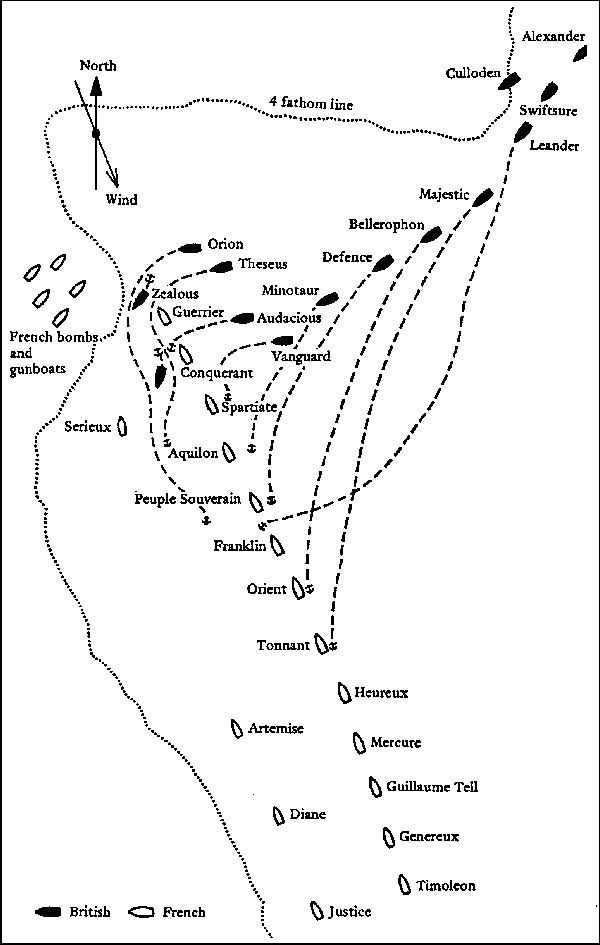
The French Wars lasted from 1792 to 1806. In May 1798, Napoleon Bonaparte
was sent to capture Egypt. His fleet led by Vice-Admiral Brueys was attacked
by the British fleet led by Rear Admiral Horatio Nelson on August 1st,
1798 where the Battle of the Nile (or Aboukir Bay) took place. Here is
an excerpt of the action:
"As it grew dark Nelson's leading ship, the Goliath led the
way inside the French line, the Zealous, Orion, Theseus and Audacious
following suit., Nelson's flagship, Vanguard, now came up on the outside
of the French line, supported by the Minotaur and Defence. This was
the situation that Nelson had wanted, with five French ships overwhelmed
by eight British opponents. They were the oldest and weakest French
ships. They had been ready to engage with the seaward battery and were
caught with their guns not even run out. Several had opponents on either
side. It was now dark and the Bellerophon engaged the Orient. The Majestic
went on to engage L'Heureux and ended up
exchanging broadsides with Le Mercure. The three rear French ships were
left without opponents. At this time, with victory already certain,
Nelson was wounded. He was on deck again later and retained command."
The L'Heureux with 74 guns and 700 men surrendered to the British.
Further readings
Back to Top |